Technology usage is the amplifier of human potential: it can connect communities, solve complex problems, and expand creativity—or it can isolate, addict, and harm when misused. The key is intentional design that prioritizes human wellbeing, ecological limits, and equitable access over unchecked growth or profit.
Technology usage – tools for empowerment
Technology should enhance life without dominating it. Over the past century, innovations like electricity, computing, the internet, and mobile connectivity have compressed distance, accelerated learning, and extended lifespans—but they have also created challenges like digital divides, surveillance risks, e-waste mountains, and mental health strain from overuse.
Future technology must solve these issues while tackling climate change, health crises, and inequality. This requires balancing rapid innovation with ethical guardrails, digital literacy for all, and sustainable material cycles.
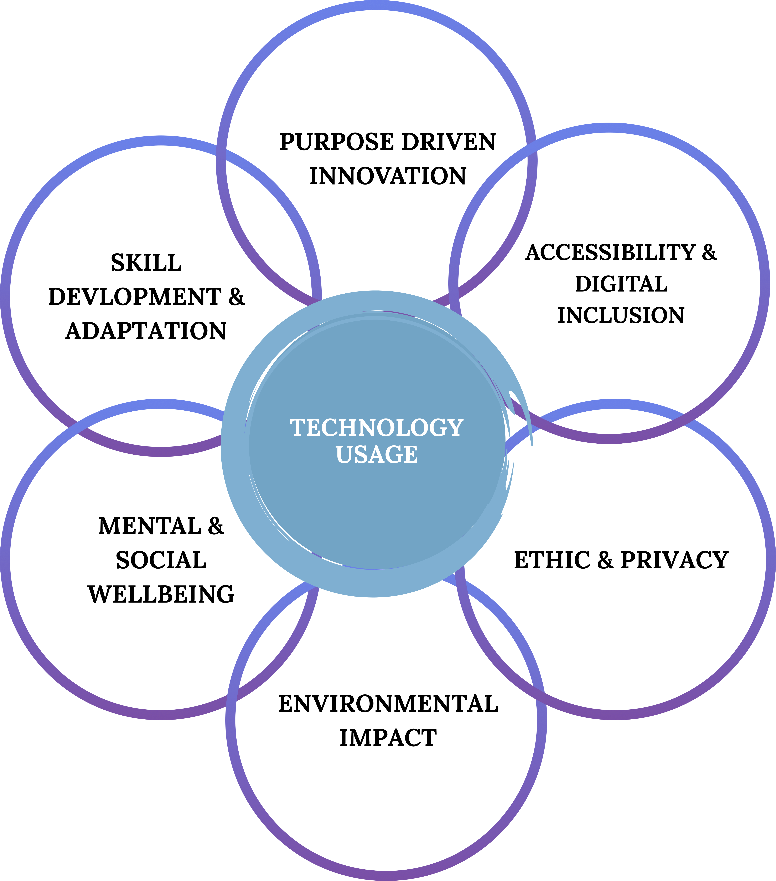
Six core factors for responsible technology
- Purpose-driven innovation
Technology solves real problems (clean water access, disease diagnosis, climate monitoring) rather than creating artificial needs (endless scrolling, planned obsolescence).- Focus: community-led tech development addressing local challenges like agriculture optimization, disaster response, or education access.
- Accessibility and digital inclusion
No one left offline: rural, elderly, low-income, and disabled people need equal access to tools, training, and safe internet.- Practical steps: community Wi-Fi hubs, low-cost devices, multilingual interfaces, and digital literacy programs for all ages.
- Ethics, privacy, and transparency
Data protection, unbiased AI, clear algorithms, and human oversight prevent harm and build trust.- Practical steps: privacy-by-design, open-source alternatives, community data governance, and ethical review boards for public tech projects.
- Environmental sustainability
Tech’s footprint—manufacturing, energy use, rare earth mining, e-waste—must shrink through circular design and renewable power.- Practical steps: modular/repairable devices, right-to-repair laws, recycled materials, and energy-efficient data centers powered by local renewables.
- Mental and social wellbeing
Technology supports real relationships and reflection, not addiction or isolation.- Practical steps: screen-time limits in schools, digital sabbaths, apps that promote face-to-face connection, and platforms rewarding quality over virality.
- Skill development and adaptation
Continuous learning ensures people thrive alongside automation rather than being displaced by it.- Practical steps: lifelong learning hubs, maker spaces, coding for non-programmers, AI literacy, and reskilling for green/digital jobs.
Technology’s century-long arc
1920s–1940s: Electrification, radio, penicillin—connected homes, spread information, saved millions of lives.
1950s–1970s: Computers, satellites—laid digital foundations.
1980s–1990s: PCs, internet—democratized knowledge.
2000s–2010s: Smartphones, social media—global instant connection.
2020s: AI, biotech, renewables—systems thinking at scale.
Each wave brought progress and problems; wise societies learned from both.
Using technology for universal benefit
Right way:
- Augment, don’t replace: Tools that help farmers predict weather, doctors diagnose faster, teachers personalize learning.
- Digital literacy first: Critical thinking, fact-checking, safe online behavior taught from childhood.
- Public-good focus: Tech improving healthcare access, disaster warnings, civic participation, environmental monitoring.
- Right to disconnect: protecting time for family, nature, reflection.
- Community ownership: local data centers, open-source platforms, cooperative broadband.
Avoid: surveillance capitalism, addictive design, planned obsolescence, extractive data practices.
Future technology horizons
Near-term (5–10 years):
- AI assistants for personalized education/health, precision agriculture, climate modeling.
- Advanced batteries enabling 100% renewable grids.
- Biotech for disease prevention, food security.
Mid-term (10–20 years):
- Quantum computing for materials discovery, drug design.
- Fully circular electronics (biodegradable, self-repairing).
- Autonomous systems for dangerous work (mining cleanup, disaster response).
Long-term (20+ years):
- Brain-computer interfaces for learning/therapy (ethical concerns first).
- Fusion energy, space-based solar.
- Synthetic biology for carbon drawdown, clean manufacturing.
Guiding principle: Technology invisible when working well—quietly amplifying human capability while shrinking ecological footprint.
Ideal technology ecosystem
A mature technology system:
- Powered by renewables: solar, wind, geothermal—data centers as grid stabilizers.
- Universal access: offline-first apps, community devices, voice/multilingual interfaces.
- Privacy-respecting: data minimization, federated learning, user-owned data.
- Circular lifecycle: modular design, easy repair, full recycling, no planned obsolescence.
- Wellbeing-optimized: nudges toward balance, connection, nature time.
- Community-governed: local control over infrastructure, algorithms serving public interest.
- Regenerative: tech restoring ecosystems (AI for reforestation, ocean cleanup).
Technology becomes the quiet infrastructure of flourishing, not the center of attention.
How to contribute to this component
Help build this Technology Usage base by:
- Developing or sharing open-source tools solving local problems (community apps, farm sensors, education platforms).
- Offering digital literacy training for elders, rural users, small businesses.
- Creating community tech labs/maker spaces with repair stations and learning equipment.
- Documenting sustainable tech practices (solar-powered schools, low-energy networks).
- Discussing ethical boundaries for AI, biotech, surveillance in your context.
Contributions ensure technology empowers rather than extracts, connects rather than isolates, and serves generations to come.


