External relations are the diplomatic nervous system of communities and nations: they manage cooperation, trade, conflict, and shared challenges across boundaries. History shows that identity-based conflicts—rooted in historical grievances, resource competition, and power imbalances—arise at every scale, from local ethnic tensions to great-power rivalries, but they can be transcended through mutual respect, shared vision, and adaptive institutions.
External relations – cooperation and peace
Self-sufficiency strengthens communities, but isolation weakens them. Healthy external relations recognize sovereignty while fostering exchange, resolving disputes peacefully, and collaborating on global threats like climate change and pandemics.
Current conflicts (2026): Russia-Ukraine escalation risks NATO clashes; Gaza/Israel tensions destabilize Middle East; Sudan civil war causes mass displacement; South China Sea disputes heighten Asia-Pacific risks; West Africa insurgencies spread; US-Venezuela tensions threaten Latin America. Root causes often blend identity, resources, and power—but solutions lie in dialogue, justice, and interdependence.
A common vision: Humanity as one extended family, diverse yet united by shared destiny, planetary stewardship, and mutual flourishing. Here are 6 factors to consider in this regards:
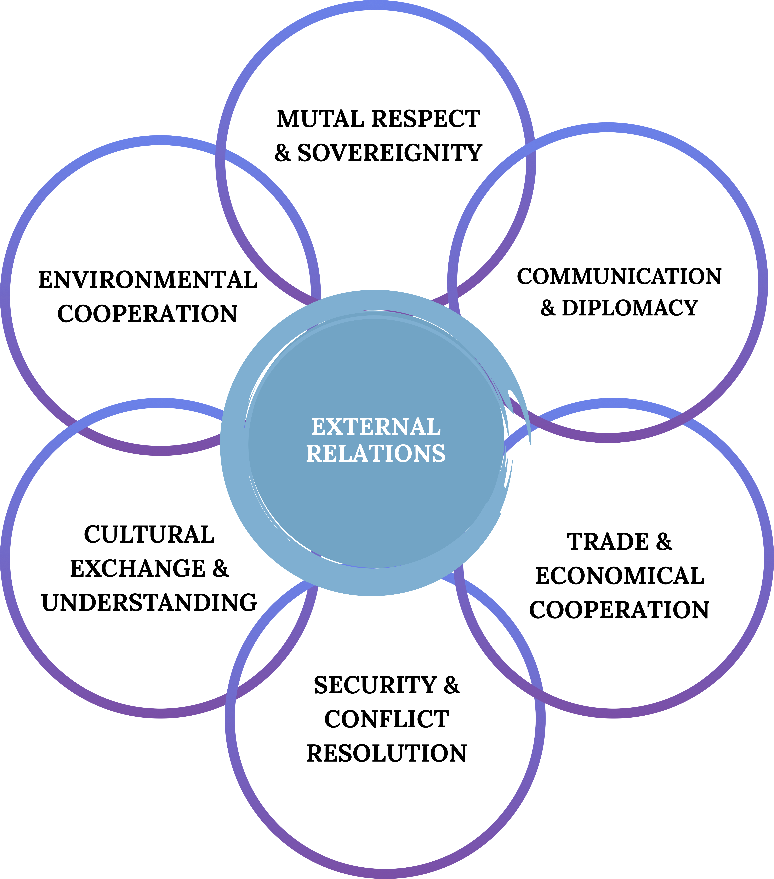
Six core factors for peaceful relations
- Mutual respect and sovereignty
- Honor each group’s autonomy, culture, and right to self-determination.
- Practical: formal recognition agreements, non-interference pacts, cultural exchange programs.
- Communication and diplomacy
- Open, regular channels prevent misunderstandings.
- Practical: hotlines, joint committees, people-to-people diplomacy (youth/sports exchanges).
- Trade and economic cooperation
- Fair exchange builds interdependence deterring conflict.
- Practical: local barter networks, regional trade blocs with equity clauses, joint ventures.
- Security and conflict resolution
- Peaceful mechanisms over violence.
- Practical: mediation councils, international courts, peacekeeping with local buy-in (e.g., Liberia UNMIL success).
- Cultural exchange and understanding
- Empathy dissolves “otherness”.
- Practical: language learning, festivals, student exchanges, joint arts projects.
- Environmental cooperation
- Shared ecosystems demand unity.
- Practical: transboundary river pacts, climate migration lotteries, joint adaptation funds.
Importance of Having Good External Relationships
- Peace and Stability: Minimizes conflicts and promotes global safety.
- Shared Prosperity: Trade partnerships and collaborations create wealth, jobs, and innovation.
- Cultural Enrichment: Exchange of ideas, arts, and traditions enhances mutual understanding.
- Global Problem-Solving: Challenges like climate change, pandemics, and cyber threats require coordinated action.
- Human Rights & Justice: Global cooperation strengthens protections and builds accountability.
A world with strong external relations is a world better prepared for shared challenges and opportunities.
Lessons Learned from History
- War and Neglect Devastate Societies
World Wars I & II showed the catastrophic cost of poor diplomacy and unchecked rivalries. - Alliances Can Create Stability and Deterrence
The post-WWII cooperation, e.g., the United Nations and treaties like NATO, helped rebuild peace mechanisms. - Isolationism Weakens Nations
Countries that withdrew from global engagement (e.g., interwar period’s isolationism) faced economic and security drawbacks. - Interdependence Binds Humanity
Global trade and travel transformed nations from isolated actors to interconnected partners—with both benefits and vulnerabilities.
History shows that division breeds conflict, while cooperation builds resilience.
Advantages and Disadvantages of Different Ways to Deal with External Parties
A. Diplomacy
Advantages:
- Prevents conflicts
- Builds long-term relationships
- Encourages negotiation over force
Disadvantages:
- Slow process
- Can be undermined by mistrust or dishonesty
B. Trade Agreements and Economic Partnerships
Advantages:
- Shared prosperity
- Encourages mutual trust
- Creates interdependence that deters conflict
Disadvantages:
- Can create economic dependency
- May benefit stronger economies more
C. Military Alliances & Defence Pacts
Advantages:
- Collective security
- Deterrence against aggression
Disadvantages:
- Risk of escalation
- Can create rival blocs
D. Multilateral Institutions (UN, WTO, ICC, etc.)
Advantages:
- Neutral ground for conflict resolution
- Global norms and justice systems
Disadvantages:
- Can be slow to act
- Sometimes dominated by powerful nations
Present Conflicts in the World That Need to be Addressed
(Reflects global issues as of end–2025)
- Ukraine–Russia Conflict
– A major flashpoint in Europe, with humanitarian concerns and geopolitical tension. - Middle East Tensions
– Ongoing conflict in Gaza & Israel, Yemen, and regional rivalries involve multiple actors. - South China Sea Disputes
– Competing territorial claims affecting ASEAN nations, China, and the broader Indo-Pacific. - Afghanistan Instability
– Humanitarian crisis, governance vacuum, and regional security concerns. - Horn of Africa & Sahel Conflicts
– Ethnic clashes, climate stress, and extremist group activity affecting stability. - Global North–South Inequality
– Economic and climate justice gaps fueling tension between developed and developing regions.
These conflicts show that competing interests, historical grievances, and resource pressures remain core issues. External relations must be built on dialogue, justice, and equity to resolve them.
What an Ideal Future Would Look Like
Imagine a world where communities and nations exist in peaceful, respectful coexistence—each maintaining its distinct cultural identity while contributing to shared humanity.
In this ideal world:
- Dialogue and Respect Prevail
- Disputes are resolved through conversation, courts, and negotiation—not violence.
- Cultural Diversity is Celebrated
- Languages, customs, festivals, and heritage are honored, shared, and preserved.
- Equitable Cooperation
- Trade deals are fair, development aid strengthens local capacities, and policies focus on mutual gains.
- Global Frameworks of Justice
- International laws protect human rights, climate agreements safeguard the planet, and courts fairly mediate conflicts.
- Collective Problem-Solving
- Climate change, pandemics, water scarcity, migration, and economic inequality are addressed through unified action.
- Education for Global Citizenship
- People learn history, empathy, and cultural literacy—fostering curiosity and respect.
- Shared Prosperity
- Poverty is reduced, access to technology and health care becomes universal, and economic systems are fair.
The Vision
A world where:
- No culture is erased or forced to conform.
- Peace is sustained not by fear, but by mutual understanding.
- Boundaries unite more than they divide.
- Every individual sees themselves as part of one shared human story.
How to contribute to this component:
You can help build this External Relations resource by taking action at any scale—from neighborhood to global:
- Engage in local/international dialogues: Organize or join cross-community forums, peace circles, or Track 3 diplomacy events connecting youth, elders, and leaders across divides.
- Design fair trade/cooperation frameworks: Create templates for equitable barter networks, joint agricultural projects, or renewable energy sharing between neighboring communities.
- Document peacebuilding successes: Record stories of local conflict resolution (e.g., land disputes settled through mediation, ethnic festivals fostering unity) with lessons others can replicate.
- Propose migration/climate pacts: Develop model agreements for safe internal migration, shared water management, or refugee integration that balance host and newcomer needs.
- Promote cultural bridge-building: Initiate language exchange programs, joint festivals, or student exchanges that humanize “the other” through shared meals, music, and stories.
- Support economic peacebuilding: Mentor cross-border small businesses, fair-trade cooperatives, or tourism ventures that create mutual prosperity and interdependence.
- Advocate for justice mechanisms: Help establish community truth/reconciliation processes or support international courts with evidence from local conflicts.
- Educate for global citizenship: Create school/workplace programs teaching conflict history, empathy skills, and cooperative games that build peacemaking instincts early.
- Build digital peace platforms: Develop multilingual apps for real-time translation, conflict alerts, or citizen diplomacy connecting divided communities.
Every small act of understanding multiplies: from sharing tea across fences to mediating trade disputes, contributions weave the common vision of humanity as one extended family.


