Population and demography form the human foundation of every society: they determine workforce size, resource needs, innovation capacity, and care demands. UN World Population Prospects 2024 projects global population peaking mid-2080s at 10.3 billion before gradual decline to 10.2 billion by 2100, with fertility below replacement (2.1) in over 50% of countries—marking a shift from growth to balance.
Population & demography – planning balanced growth
Sustainable demography ensures resources, opportunities, and care systems match human numbers and needs. It requires empowering families, women, and youth while adapting to ageing, migration, and urbanization.
Current trends: slowing growth (TFR 2.3 globally), ageing in East Asia/Europe (Japan TFR 1.2), youth bulges in Africa/South Asia (potential demographic dividend if education/jobs align), and 70% urban by 2050—plus climate migration displacing 216 million internally by 2050. Here are 6 factors to consider in this regard.
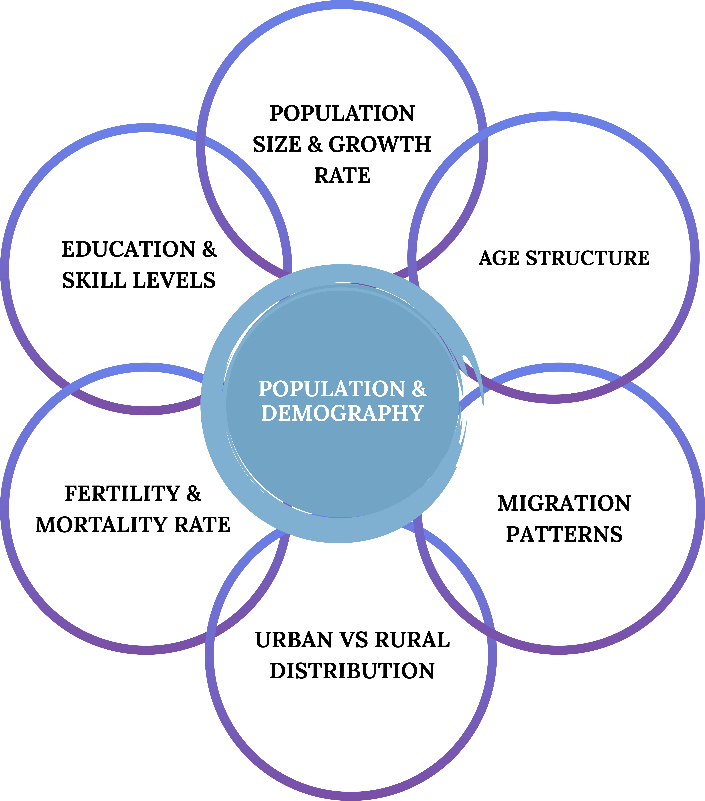
Six core factors
- Population size & growth rate
- Too rapid growth strains resources; too slow risks labour shortages.
- Practical: voluntary family planning, education (women’s literacy correlates with 1–2 fewer births), healthcare access.
- Age structure
- Youth bulges offer dividends (India/Africa: 800M workforce entrants by 2050); ageing demands care innovation.
- Practical: youth skills training, eldercare systems, immigration policies.
- Migration patterns
- Internal climate migration: 216M by 2050 (86M Sub-Saharan Africa).
- Practical: resilient rural areas, urban integration, safe migration corridors.
- Urban vs. rural distribution
- 70% urban by 2050 strains cities but boosts productivity.
- Practical: compact “15-min cities”, rural revitalization via renewables/agritech.
- Fertility & mortality rates
- Global TFR 2.3; below 2.1 in 110+ countries. Mortality falls with health/education.
- Practical: reproductive health, nutrition, vaccination.
- Education & skill levels
- Educated populations drive innovation, lower fertility responsibly.
- Practical: universal quality education, lifelong learning.
Importance of Understanding Population & Demography
- Guides Policy & Planning: Governments plan schools, hospitals, housing, and infrastructure based on demographic data.
- Predicts Future Needs: Helps forecast food demand, energy use, jobs, and social welfare requirements.
- Supports Economic Growth: Understanding the workforce structure helps nations prepare for future industries and skill gaps.
- Improves Resource Management: Population insights shape environmental policy, water use, and sustainable development.
- Strengthens Social Stability: Identifies vulnerable groups—elderly, children, migrants—ensuring inclusive policy-making.
- Shapes Cultural & Ethical Understanding: Demography reveals how societies change, adapt, and interact over time.
In short, demography acts as the backbone of national planning and global foresight.
Lessons Learned from History
- Population Booms Create Both Opportunity and Stress
- Industrial Revolution saw massive population growth → led to innovation but also poor living conditions.
- Post-WW2 “baby boom” shaped modern economies.
- Population Declines Can Weaken Nations
- Ancient Greece and Rome faced collapse partly due to falling birth rates and demographic imbalance.
- Japan today struggles with an aging population and shrinking workforce.
- Migration Builds Civilizations
- America’s cultural and economic power grew from immigration waves.
- Ancient trade routes thrived because people moved, exchanged ideas, and mixed cultures.
- Pandemics Remind Us of Vulnerability
- The Black Death in the 14th century reshaped Europe’s economy and workforce.
- COVID-19 highlighted the importance of health systems and population resilience.
History shows: A society’s strength lies in balanced population, movement of people, and adaptability to demographic change.
Present Global Understanding & Where It Is Headed
Current Global Trends (2025)
- Slowing Global Population Growth
The world’s population is still rising but at a historically low rate. Many developed nations now have fertility rates below replacement level. - Rapid Aging in Many Countries
Japan, South Korea, Italy, Spain, and China face shrinking working-age populations and rising elderly care needs. - Youth Bulge in Developing Nations
Countries in Africa, South Asia, and parts of the Middle East have very young populations—creating potential for growth if education and jobs keep pace. - Urbanization Accelerating
More than half the world now lives in cities; this is expected to reach 70% by 2050, increasing demand for smart planning. - Migration Becoming Central
Climate migration, conflict displacement, and economic migration will shape future demographics. Coastal populations especially face relocation pressures. - Changing Family Structures
Smaller families, later marriages, and more independent living are becoming common worldwide.
Where It Is Headed
- Global Population May Peak Around 2080
Many forecasts suggest the world’s population could start declining later this century. - A New Balance of Power
Countries with stable or growing young populations (India, Indonesia, some African nations) may become future economic hubs. - AI and Automation Will Offset Labor Shortages
Aging societies will increasingly depend on robots, AI, and smart systems for healthcare, manufacturing, and logistics. - Climate Change Will Redraw Demographic Maps
Rising temperatures, water stress, and sea-level rise will push people toward safer regions, altering urban and national boundaries. - Education Becomes the Key Demographic Force
Nations that invest in women’s education, skill development, and health will see stable populations with strong economic growth. - A More Interconnected World
Communications, global mobility, and digital migration will create new forms of identity and demographic diversity.
The central insight for the future: The world will not struggle with too many people—but with imbalanced populations. Managing that balance will define the next century.
How to contribute to Population & Demography (expanded)
You can help strengthen this Population & Demography component by supporting balanced communities through practical action:
- Design family planning/education programs: Create accessible reproductive health workshops, youth education on family choices, or mobile clinics reaching rural areas.
- Map local demographic trends: Collect and analyze community data on birth rates, migration patterns, ageing, or youth unemployment to inform local planning.
- Share youth/eldercare innovations: Document successful models like intergenerational housing, community daycare, or skill-sharing between generations.
- Support women’s empowerment initiatives: Launch vocational training, literacy programs, or childcare cooperatives that enable women to balance family and work.
- Plan for climate migration: Develop model agreements for welcoming internal migrants, shared resource plans between sending/receiving areas, or resilient rural revitalization.
- Build demographic dividend strategies: Create youth employment pipelines (apprenticeships, green jobs, digital skills) to harness population potential.
- Establish community care systems: Organize elder buddy programs, childcare cooperatives, or multi-generational living experiments addressing ageing challenges.
- Conduct local population foresight: Run scenario planning workshops asking “What if our population doubles/halves in 20 years?” to build adaptive strategies.
- Document cultural adaptations: Record how communities successfully navigate falling birth rates, migration waves, or ageing through family support innovations.
- Advocate for balanced policies: Propose local incentives supporting family wellbeing (parental leave, affordable housing, flexible work) without coercion.
Every family thrives when demography serves people: Contributions turn population statistics into community wisdom for sustainable flourishing.


