Economy is the circulatory system of a community: it determines how resources flow, how people contribute and thrive, and how societies weather crises. A healthy economy measures success not just by GDP growth, but by wellbeing, equity, and long-term sustainability—ensuring that prosperity lifts everyone without exhausting people or planet.
Economy – prosperity with purpose
An economy should serve life, not trap it. It must balance material needs (food, shelter, healthcare, education) with human flourishing (meaningful work, creativity, security) while respecting ecological limits. History shows that economies collapse when they overexploit resources, concentrate wealth, or ignore social bonds; they thrive when they align incentives with shared long-term goals.
Modern challenges include rising inequality (top 1% hold nearly half of global wealth), climate costs (projected $23 trillion/year by 2050), automation displacing routine jobs, and fragile global supply chains exposed by recent crises. Future economies will succeed by prioritizing resilience, regeneration, and inclusion over endless extraction.
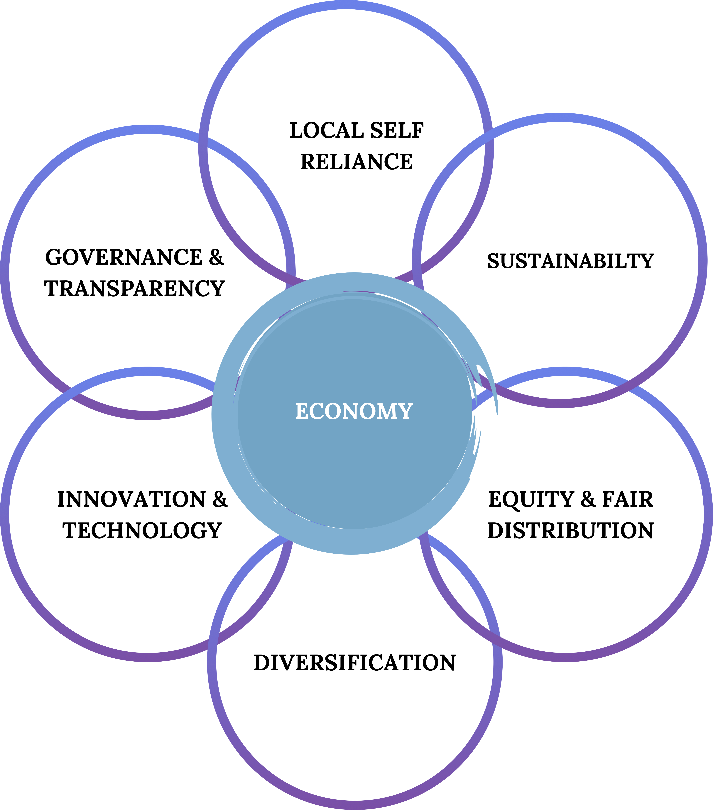
Six core factors of a healthy economy
- Sustainability
Growth must regenerate natural capital (soils, forests, water, biodiversity) rather than deplete it.- Practical focus: circular economy models, renewable energy jobs, regenerative agriculture, and policies that internalize environmental costs (carbon pricing, pollution fees).
- Equity and fair distribution
Extreme inequality erodes trust, health, and stability; economies perform better when income gaps are narrow and opportunities are accessible.- Practical focus: progressive taxation, universal basic services (healthcare, education), living wages, and cooperative ownership models that share profits widely.
- Diversification
Single-sector dependence (oil, tourism, manufacturing) creates fragility; diverse economies spread risk and create multiple pathways.- Practical focus: support local food systems, crafts, digital services, care work, and green tech alongside traditional strengths.
- Innovation and technology
Continuous learning and adaptation keep economies competitive while creating meaningful jobs.- Practical focus: invest in skills (digital, green, creative), open-source tools, community R&D, and technology that augments rather than replaces human work.
- Governance and transparency
Corruption-free, accountable systems build trust and attract investment; opaque governance repels it.- Practical focus: participatory budgeting, open contracting, anti-corruption watchdogs, and clear rules that favor long-term stewardship over short-term gain.
- Local self-reliance
Global trade works best when complemented by strong local production of essentials (food, energy, care).- Practical focus: community currencies, local procurement policies, food sovereignty, and decentralized energy and manufacturing.
Why economy matters for communities
A strong local economy delivers:
- Quality of life: reliable access to food, housing, healthcare, education, and clean environments.
- Employment and purpose: meaningful livelihoods that match people’s skills and community needs.
- Public services: funding for schools, clinics, parks, emergency response, and cultural preservation.
- Resilience: ability to absorb shocks (pandemics, climate events, market crashes) without collapse.
- Social harmony: reduced poverty and inequality lower crime, stress, and social tensions.
Economies that concentrate wealth in few hands or prioritize short-term profit over planetary health create fragility; inclusive, regenerative systems build enduring strength.
Lessons from economic history
History reveals recurring patterns:
- Overdependence destroys: civilizations like Easter Island and Mesopotamia collapsed when soil, forests, or single resources were exhausted.
- Trade builds prosperity: Silk Road networks, Hanseatic League, and modern supply chains show mutual benefit from exchange.
- Inequality destabilizes: French Revolution, 20th-century populism, and recent unrest trace back to wealth concentration without broad opportunity.
- Institutions enable recovery: post-WWII Japan, South Korea, and Germany rebuilt through disciplined governance, education investment, and export strategies.
- Regulation prevents crashes: Great Depression and 2008 crisis showed speculation needs boundaries; Nordic models balance markets with strong safety nets.
Key insight: Economies endure when they serve people and planet, not when people and planet serve narrow interests.
Economic models – strengths and limits
No perfect system exists; hybrids often work best:
Capitalism (market-driven)
- Strengths: innovation, efficiency, rapid wealth creation.
- Weaknesses: inequality, environmental externalities, boom-bust cycles without regulation.
Socialism (state-planned)
- Strengths: equity, universal services, poverty reduction.
- Weaknesses: inefficiency, stifled innovation, corruption risks in centralized power.
Mixed economy (most nations today)
- Strengths: balances markets with welfare; flexibility.
- Weaknesses: can drift toward either extreme; vulnerable to lobbying and short-termism.
Traditional/local economies
- Strengths: sustainable, community-rooted, low external dependency.
- Weaknesses: limited scale, vulnerability to local shocks.
Emerging models (regenerative, doughnut economics, commons-based):
- Integrate ecological limits, wellbeing metrics, and shared ownership; still experimental but gaining traction.
Current global economy (2026) and future direction
Present status:
- Slow growth amid inflation, debt, and geopolitical tensions.
- AI/automation accelerating, displacing routine jobs but creating demand for creative, care, and green roles.
- Climate costs rising; green tech (renewables, batteries, carbon capture) growing fastest.
- Inequality persistent; youth unemployment high in many regions.
- Supply chain fragility exposed; governments pushing “friendshoring” and local production.
Future trajectory:
- Green transition dominates: net-zero industries, circular materials, climate adaptation services.
- Digital-physical fusion: AI-augmented work, blockchain for transparency, remote collaboration.
- Care and regeneration rise: economies valuing eldercare, mental health, ecosystem restoration.
- Decentralized models: community energy, local currencies, platform cooperatives.
- Wellbeing metrics: Bhutan-style Gross National Happiness, OECD Better Life Index gaining policy influence.
Vision of an ideal community economy
A future-ready local economy:
- Regenerative: grows wealth while restoring soils, forests, and waters.
- Inclusive: every adult and youth has dignified work; no one falls through cracks.
- Balanced: global trade + local self-reliance in food, energy, care.
- Transparent: corruption minimized; budgets and contracts open to scrutiny.
- Adaptive: continuous learning, experimentation, and cross-sector collaboration.
- Human-scale: prioritizes time, relationships, health over endless accumulation.
In short: economic growth serves people and planet, reversing extractive patterns.
How to contribute to this component
You can enrich this Economy base by:
- Mentoring small businesses, cooperatives, or social enterprises in your community.
- Supporting or starting local markets, repair cafés, or circular production initiatives.
- Sharing case studies of economic models that worked locally (community-supported agriculture, energy co-ops, fair trade crafts).
- Designing tools for circular economy tracking (material flows, repair rates, local GDP multipliers).
- Discussing policies that align markets with community wellbeing (land value capture, basic income pilots, green procurement).
Contributions help communities build economies that are prosperous, just, and enduring.


